The Walkscape Award: Lund 2039
Lund Walkscape Award was a performance theater piece conducted by Climaginaries in the city of Lund in 2025. The performance took place in 2039, when the city has just received an international prize for becoming one of the world’s most walkable and sustainable urban environments. The jury is coming to Lund to hand over the price, and both local politicians and citizens are invited to attend the price cermony.
Lund Walkscape Award was comprised of two part: a non-interactive exhibition of how the transition took place, as well as an interactive lecture and Q&A with both a fictional civil servant from the future and present day local politicians. The performance was designed as a whole staged situation rather than a single artefact. It starts from research on urban mobility — on how car dominance shapes cities, how walking is systematically undervalued, and how streets, parking, and accessibility are deeply political questions.
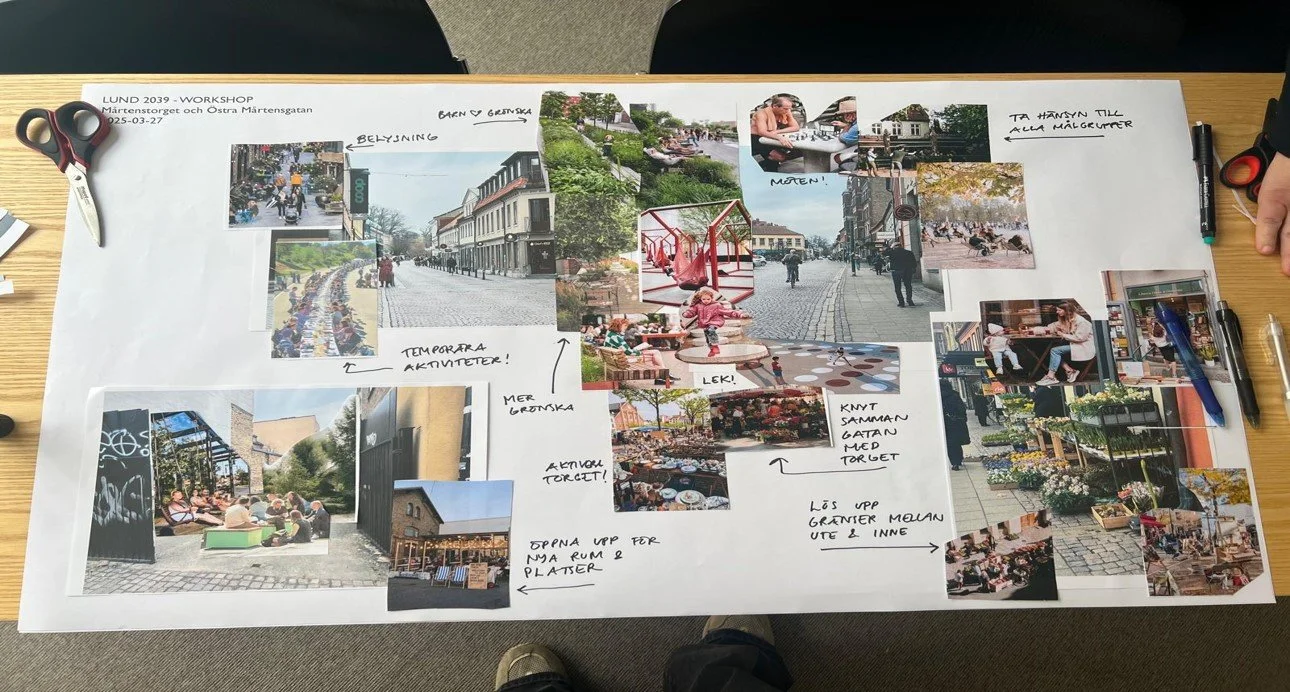
That research was then combined with participatory workshops, scenario-making, and speculative visual material. Local actors, planners, designers, and residents were all involved in imagining how Lund could actually move from car-dependency to walkability.
The project takes the form of an exhibition and a performance lecture set in the year 2039. Visitors are not treated as spectators, but as if they are present in 2039, attending a public event about how this transformation happened.
During the Q&A part of the performance people could ask what went wrong, what was contested, who resisted, and who benefited. Parts of it are improvised, which means the future is not fixed — it is negotiated live in the room. In this way, the Walkscape Award turns something very technical — transport planning and mobility policy — into a shared political drama about space, power, and everyday life. It doesn’t just show what a walkable city might look like, but lets people experience what it might have taken to get there.
This is where the Walkscape Award went beyond being a nice story. It was not a scenario in the usual sense, but a staged award ceremony in 2039 — an exhibition and a public event that acts as a portal into a walkable future. By treating that future as already achieved, the performance makes the present strange. It exposes all the hidden assumptions we normally carry about cars, streets, parking, and movement. The audience asked real politicians and planners to answer questions as if it were 2039 — to explain how Lund managed to become walkable, who resisted, and what was sacrificed. Because it is improvised, it is not possible to hide behind prepared statements, and the respondents are forced to inhabit that future in real time.
This is where the fiction loops back into politics. The imagined award creates a simple, unsettling question in the room:
“If we want to deserve this future, what would we have to start doing differently today?”